
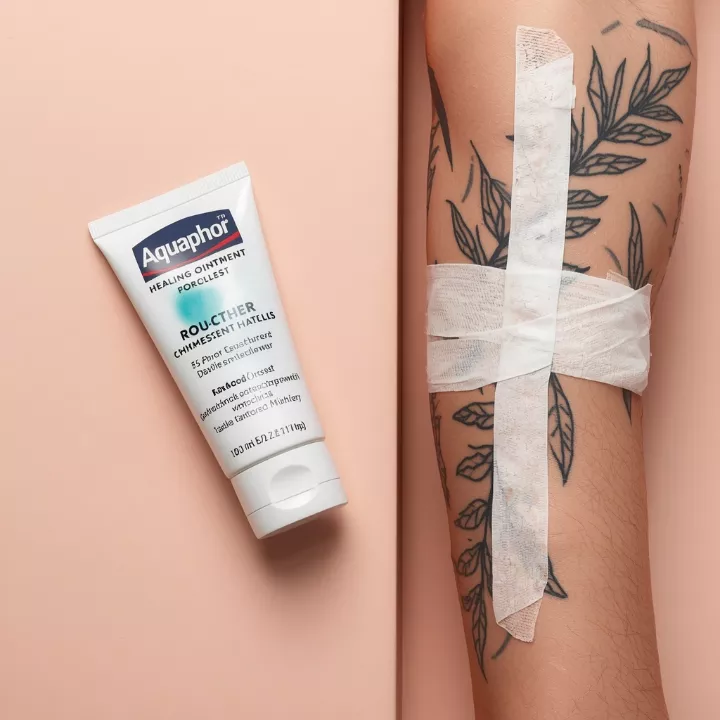
 h2>The short answer: Is Aquaphor suitable for a new tattoo?
Standard US Aquaphor Healing Ointment can be used on a new tattoo as a moisture barrier, with one important qualification. Its Drug Facts label lists petrolatum 41% as the active ingredient and classifies it as a skin protectant, with labeled uses that include temporarily protecting minor cuts, scrapes, burns, and chapped or cracked skin. Tattoo aftercare is not a specific labeled indication, so applying it to a fresh tattoo is an off-label use.
Off-label does not mean unsafe or inappropriate. It means the product was not formally cleared for this particular purpose, and that being widely used in tattoo aftercare is not the same as being clinically proven or approved for tattoos. Many people reach for it because a petrolatum ointment protects healing skin, but that familiarity does not elevate it to an evidence-backed tattoo treatment.
The more reliable guide is the instruction you already have. Your tattoo artist's aftercare directions, and the directions for whatever dressing or product they recommend, take priority over any single routine you read online. The American Academy of Dermatology likewise advises following the tattoo artist's aftercare instructions, washing the tattoo gently, keeping it appropriately moisturized, avoiding scratching or picking, and keeping it out of water while it heals. If Aquaphor fits within those instructions, it can serve as one option for keeping the skin from drying out. If your artist recommends something different, follow their plan rather than defaulting to an ointment because it is popular.
What Aquaphor does-and does not do-for tattooed skin
Petrolatum works by forming an occlusive film over the skin. That film reduces how much water evaporates from the surface, which helps healing skin stay supple and less prone to tight, uncomfortable dryness. This is skin protection in the literal sense: a physical barrier that slows moisture loss. It is not an antibacterial treatment, and it does not act on the tattoo pigment itself.
The standard US formula pairs petrolatum with inactive ingredients such as mineral oil, ceresin, lanolin alcohol, panthenol, glycerin, and bisabolol. That composition applies to the standard US Healing Ointment specifically. Other Aquaphor-branded products, and formulations sold in other countries, should not be assumed to contain the same ingredients, so the label on the exact tube you own is what matters.
Several claims that circulate about Aquaphor and tattoos go beyond what a skin protectant does. It does not “let the skin breathe,” draw ink out of the skin, prevent infection, speed up tattoo healing, or preserve tattoo color. There is also no basis for the blanket claim that it cannot clog pores. Treating it as a barrier that keeps healing skin from drying out is accurate; treating it as a healing accelerant or an infection shield is not. Keeping those expectations realistic helps you judge whether it is doing a useful job or whether a different approach would serve the tattoo better.
How to use Aquaphor without overapplying it
If Aquaphor is part of the routine your artist recommends, the practical sequence matters more than any fixed schedule. Start with the dressing instructions you were given, since those determine when the initial covering comes off and how the tattoo is cared for underneath. When it is time to apply anything, wash your hands first, clean the tattoo gently as directed, and let the skin dry before touching it. Then spread only a very thin film over the area.
Thin is the key idea. A barely-there layer that mostly disappears into the skin is enough to slow moisture loss. If the surface looks shiny, slick, or coated, you have used too much, and the excess should be gently blotted away. A new tattoo should not sit buried under a thick, continuously greasy coating.

The reason to keep it sparse is biological. Occlusive products reduce water loss, but too much occlusion for too long can trap moisture against the skin and contribute to maceration, irritation, or small follicular bumps that resemble folliculitis. The amount you apply, how long it stays on, and the condition of the skin all influence whether occlusion helps or hinders.
There is no single correct start time, number of daily applications, rewrapping pattern, or number of days to continue, because dressing types and artist protocols genuinely differ. Let the instructions for your specific situation set the timing, and use the thin-film principle to govern how much goes on each time.
Aquaphor and Tattoo Aftercare
When to switch from ointment to a lighter moisturizer
The move from a heavy ointment to a lighter product is better judged by how the skin looks and feels, and by your artist's guidance, than by a calendar date. A petrolatum ointment is generally an early-stage choice while the tattoo is newest and most in need of a protective barrier. As healing progresses, a bland, fragrance-free moisturizer often feels more comfortable and less heavy.
A reasonable signal for considering the switch is when any marked weeping or oozing has stopped and the surface has started to dry out or flake in the way healing skin normally does. At that point a thinner, non-greasy moisturizer can keep the skin hydrated without the drawbacks of maintaining a thick occlusive layer longer than it is useful.
The important distinction is between ordinary dryness or peeling and something that looks like a complication. Light flaking and tightness as skin recovers are different from spreading redness, increasing pain, or discharge, and the presence of those latter signs is a reason to seek advice rather than simply change moisturizers. Do not read rigid healing “stages” into this; skin varies.
Switching products does not make ink settle, guarantee richer color, or count as a medically required step for every tattoo. It is a comfort-and-skin-condition decision, not a treatment that changes the outcome of the tattoo itself.
When Aquaphor may be the wrong choice
The standard US Aquaphor Healing Ointment contains lanolin alcohol, and lanolin and its derivatives can cause allergic contact dermatitis in susceptible people, particularly on damaged or inflamed skin. A fresh tattoo is exactly that kind of vulnerable surface. If applying the ointment seems to bring on a worsening localized rash, increasing itch, or growing irritation at the site, stop using it and seek professional advice if the reaction is significant or persistent.
Irritation or an allergic reaction to the product is not the same as an infection, even though both can look red and uncomfortable. A reaction tied to applying a specific product, concentrated where the product was spread, points toward contact irritation or allergy, while other patterns may suggest infection. When the cause is genuinely unclear, a clinician is the right person to sort it out.
Ingredient preferences are a separate matter. Readers who avoid animal-derived ingredients may not want a lanolin-containing formula, which is a reasonable personal choice rather than a safety problem in itself.
Because Aquaphor products and regional formulations can differ, check the label on the exact product you have. The ingredient list that applies to the standard US Healing Ointment may not match another Aquaphor item or a version sold elsewhere, so the tube in your hand is the one that counts.
Essential aftercare beyond moisturizing
Moisturizing is one piece of aftercare, not the whole of it. Follow the dressing instructions your artist gave you, keep the area clean with gentle washing, and resist the urge to scratch or pick at it as it heals. Avoid soaking the tattoo, since immersion while skin is still healing works against recovery. Protect the area from direct sun as advised, since ultraviolet exposure can contribute to fading and skin damage; during healing, physical coverage and staying out of direct exposure are the appropriate approach.

A product applied to the surface cannot make up for the basics. No ointment compensates for poor hygiene, for soaking a healing tattoo, or for leaving it exposed to strong sun. Those exposures can undermine healing regardless of how carefully you moisturize.
Timelines for rewrapping, when swimming is safe, when sunscreen is appropriate on the area, and when a tattoo is fully healed all depend on the dressing type, how closed the skin is, the characteristics of the tattoo, and your artist's advice. Sunscreen in particular should follow its own product directions and should not be treated as suitable for an open or incompletely healed wound without professional guidance.
Irritation, allergy, and possible infection: When to seek help
Minor irritation localized to where a product was applied is different from signs that suggest something more serious. Watch for redness that worsens or spreads beyond the tattoo, pain or swelling that keeps increasing, pus or other drainage, red streaking from the site, or fever or chills. Any of these can indicate infection and warrant prompt medical assessment rather than waiting to see if it settles on its own.
Your tattoo artist can advise on routine aftercare, but that guidance does not replace clinical evaluation when these warning signs appear. If you suspect an infection, do not try to manage it with Aquaphor; a skin protectant is not a treatment for infection, and delaying care can allow a problem to progress.
Certain symptoms call for emergency care immediately: difficulty breathing, or swelling involving the face, lips, tongue, or throat, which can signal a severe allergic reaction.
A tattoo's appearance alone cannot tell you with certainty whether redness, itching, peeling, discharge, or bumps are harmless, allergic, or infectious. That uncertainty is precisely why a professional assessment matters when symptoms are worsening, spreading, or accompanied by the systemic signs above. When in doubt, have it looked at.